
Logan County Court Records After Arrest
The arrest-to-court path in Logan County has two record tracks. The Logan County Sheriff's Office inmate search is the custody track. It is a jail record that shows the person is held at the Logan County Detention Center, along with booking date, basic profile fields, a booking photo when available, and booking charges. The court track starts when the District 9 District Attorney's Office files a complaint, information, indictment, or other case paper in Logan County District Court.
Those court records after a jail arrest are kept through the District Court and the Logan County Court Clerk. The prosecutor can file charges that match the booking charge, but that is not guaranteed. Counts may be amended, reduced, dismissed, or declined after review. For custody and booking details, use Logan County jail inmate records. For booking photos, use the Logan County jail mugshots page. For the case itself, use the court docket and verify copies with the clerk.
The research found a source conflict on the current District Attorney's name, so the safer local label is District 9 District Attorney's Office. Logan County sources identify Laura Thomas, while Oklahoma District Attorneys Council material inspected in 2026 listed Jose Villareal as Acting DA for District 9. The office function is clear either way: the prosecutor decides what formal charges follow a Logan County arrest.
Find Logan County Court Records
Logan County District Court records are searched through the Oklahoma State Courts Network docket search. OSCN is the main free statewide court-search channel documented in the research. Searchers can use a case number if one is known from bond paperwork, a citation, or a court notice. If the case number is not known, party search is the practical route for court records after an arrest.
- Open OSCN docket search and choose the court-search area that fits the information available.
- Search by party name when no case number is known. A last name is the main field, and a first name narrows common names.
- Use a case number when bond paperwork, a clerk notice, or an attorney gives one. Oklahoma formats often use prefixes such as CF, CM, or TR.
- Open the case and compare the filed counts, events, bond entries, warrants, and settings with the jail booking record.
- Contact the Logan County Court Clerk if the online docket is unclear, sealed, juvenile, incomplete, or not enough for a certified copy.
The OSCN sample reviewed for Logan County warned that online case data is not the official record and must be checked with the record keeper. That matters when court records after an arrest will be used for a deadline, bond question, plea status, expungement review, or certified-copy request. The Logan County Court Clerk records, files, and maintains District Court proceedings and can provide case lookup help, copying, certification, schedules, and court-approved forms. Clerk staff cannot give legal advice or tell a person what to file.
The OSCN docket search page shows the official court-search layout used for Logan County case lookup.
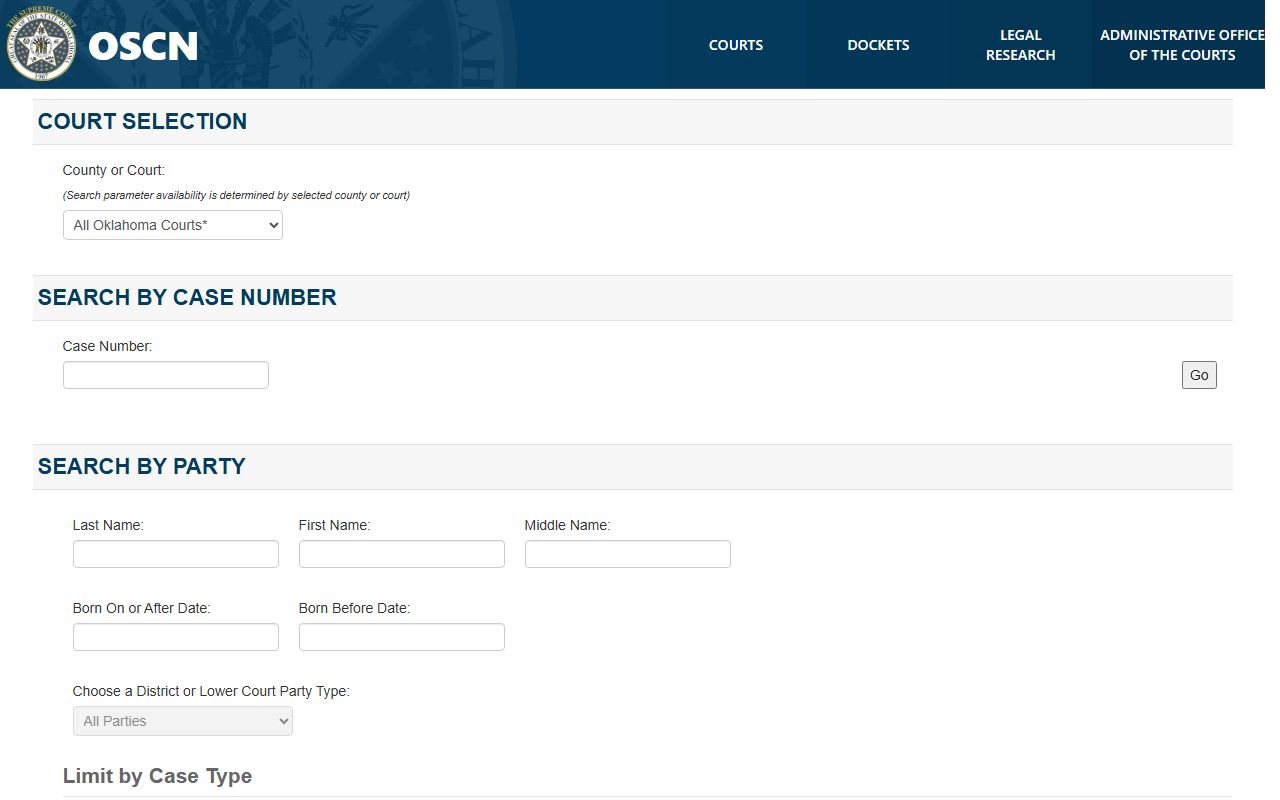
The search tabs are useful because a jail arrest may be easiest to trace by party name at first, then by case number once the prosecutor files the formal case.
Logan County Case Search Fields
OSCN does not work like the Logan County jail roster. The jail roster has a simple name filter for current custody. The court portal is organized by case number, party, lower-court case number, and traffic citation. That makes it better for tracking the filed case, but it also means the user may need a name, case prefix, or citation number.
| Search Area | Field Label | Type | Required | Notes |
|---|---|---|---|---|
| Case Number | Court selection | Dropdown | Yes | Select the relevant court database, such as Logan County District Court when available. |
| Case Number | Case Number | Text | Yes | Oklahoma examples include CF-YYYY-NNN, CM-YYYY-NNN, and TR-YYYY-NNN. |
| Party | Last Name / Business Name | Text | Usually yes | Use the defendant surname or business name for party search. |
| Party | First Name | Text | No | Narrows common names and helps match the jail booking name. |
| Lower Court | Lower court case number | Text | Yes | Used for appellate lower-case searches, not routine jail booking lookup. |
| Traffic Citation | Citation Number | Text | Yes | District Court traffic citations only, not municipal citation searches. |
The docket page may show parties, attorneys, events, filed date, judge, counts, settings, warrants, bonds, and dispositions when those items are entered. It should not be treated as a full police report or a replacement for certified clerk records.
Charges Filed After Arrest
After a Logan County jail arrest, the court case begins through a formal charging document. A booking charge is the jail's custody-side description at intake. A filed charge is the prosecutor's court-side accusation. The two often relate to the same incident, but the wording, count number, offense level, and statute can change after the District 9 District Attorney's Office reviews reports and evidence.
| Document | Who Uses It | What It Does | Why It Matters |
|---|---|---|---|
| Complaint | Law enforcement or prosecutor | Sets out the accusation used to start or support a criminal case. | May appear early after arrest, especially before more formal filings. |
| Information | Prosecutor | Lists the counts the District Attorney chooses to file in District Court. | Often controls the formal charge list for many Oklahoma felony cases. |
| Indictment | Grand jury | Charges an offense after grand-jury action. | Less common for routine jail arrests, but still a charging path. |
The Logan County docket calendar gives local setting patterns that help place a new case in context. Arraignments are listed for Tuesday and Thursday at 1:30 PM, felony dockets for the first and third Friday at 9:00 AM, misdemeanor dockets for the second Thursday at 9:00 AM, and traffic dockets for the second Wednesday at 9:00 AM. Schedules can change, so the court clerk remains the source for current settings.
Logan County Charge Status
Charge status is the part of a court record that tells whether a count is still pending, changed, or resolved. It is one reason court records after a jail arrest must be read separately from jail records. The roster can show the booking charges that brought a person into custody, while the court docket can show later prosecutor decisions, court orders, and outcomes.
| Status | Meaning in a Court Record |
|---|---|
| Pending | The charge is unresolved and the case is still moving through court. |
| Amended | The prosecutor or court changed the charge wording, count, statute, or level. |
| Reduced | The filed charge was replaced by or resolved as a lesser offense. |
| Dismissed | The count ended without a conviction on that count. |
| Nolle prosequi / declined | The prosecutor does not pursue that charge. |
| Deferred sentence | A plea or finding has conditions and may have later dismissal or expungement effects. |
| Conviction | The court accepted guilt by plea, verdict, or adjudication. |
When a status term affects release, bond, plea rights, or eligibility for expungement, the docket should be verified through the Court Clerk or an attorney. Online entries can lag or omit documents that exist in the official file.
The Logan County Court Clerk page identifies the clerk's record duties and public-help limits.
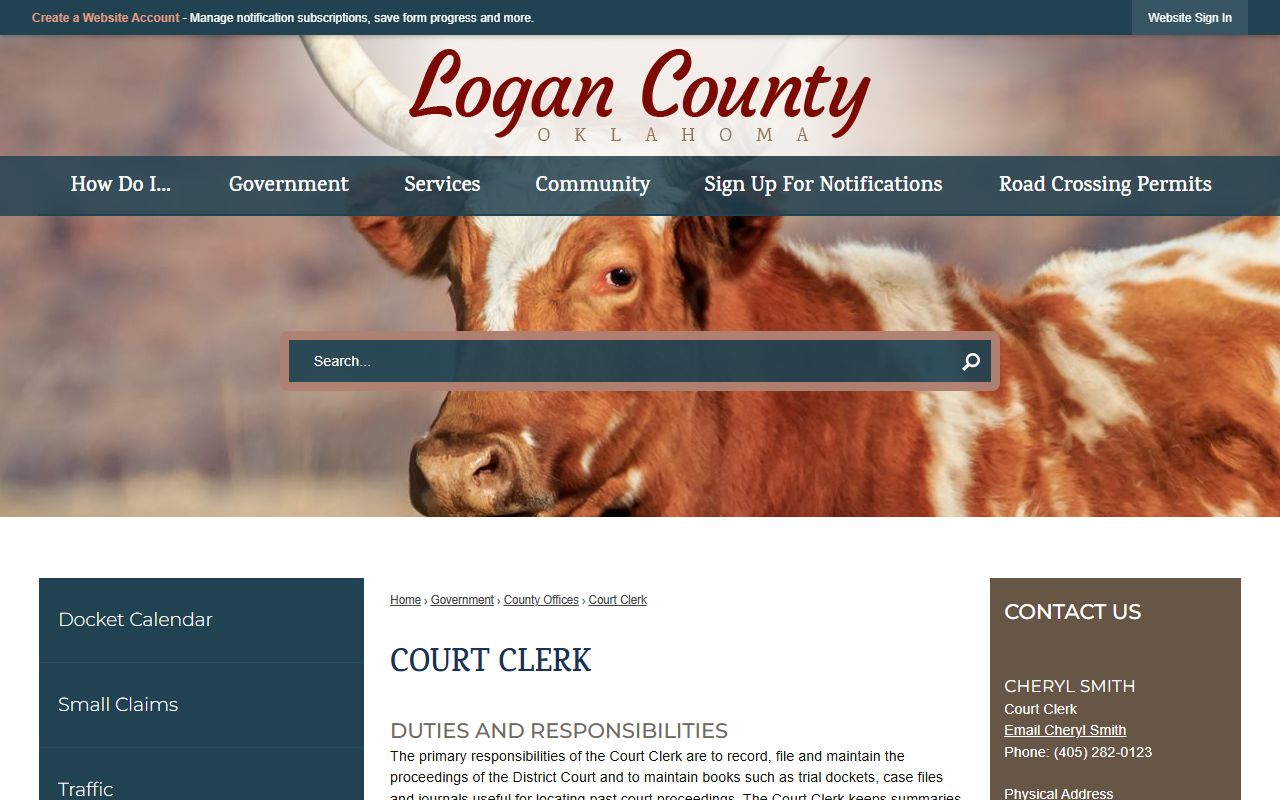
The clerk page is the local check on court records when the OSCN entry does not answer whether a charge, setting, or warrant is still active.
Bond After Logan County Arrest
Bond is tied to both custody and court records. The Logan County jail roster sample reviewed in the research did not show a bond field, so bond should not be assumed from the inmate profile. Bond may come from a warrant, preset process, or court order after first appearance. Once a case is filed, the case number and bond entries are better checked with OSCN or the Court Clerk.
| Bond Type | How It Works | Local Checkpoint |
|---|---|---|
| Cash bond | The full amount is paid in cash or approved funds to secure court appearance. | Confirm amount and acceptance rules with jail or court clerk. |
| Surety bond | A licensed bondsman posts bond under a fee or contract. | Logan County warns that bond papers must be complete and notarized. |
| Personal recognizance | The court releases the defendant on a promise to return, often with conditions. | Check the court order or docket entry. |
| No-bond hold | No bond is available, or another hold blocks release. | Ask about warrants, detainers, DOC holds, federal holds, or ICE detainers. |
The Logan County bondsmen page warns that improper bond paperwork will not be accepted, approved, or filed by the court clerk, and the defendant may be subject to re-arrest. Bonds also need case numbers after filing. That makes the court case lookup useful even when the immediate question is release from jail.
Warrants and Arrest Records
No official Logan County searchable active-warrant database was located in the research. The sheriff site has a Most Wanted page and offender resources, but not a complete public warrant portal. Warrant checks should be handled through court and sheriff channels, not private warrant aggregators. The Court Clerk issues legal warrants, subpoenas, summons, orders, processes, and writs as allowed by statute, while the Sheriff's Office works in service and enforcement roles.
A warrant can explain why a person appears in jail before a new case is filed, or why bond is blocked after a local court record appears. Court records after an arrest may show bench warrants, failure-to-appear entries, probation or parole holds, or warrant returns. If the warrant came from another jurisdiction, the Logan County booking record may show a hold while the issuing agency or court controls the next step.
Important: Active warrant questions can lead to arrest, so verify phone numbers through official sheriff or court pages before acting.
Charges vs Convictions
A charge is an accusation. A conviction is an outcome. Court records after a Logan County jail arrest can show both, but the words should not be treated as the same thing. A person may be arrested and charged, then have the count dismissed, reduced, amended, deferred, or resolved by plea or trial. The public court record should be read for the current status of each count.
| Point | Charge | Conviction |
|---|---|---|
| Stage | Accusation filed or listed after arrest. | Final or accepted finding of guilt by plea, verdict, or adjudication. |
| Proof level | Based on probable cause or prosecutor filing decision. | Requires plea or proof beyond a reasonable doubt. |
| Record effect | May remain visible while pending or after dismissal unless sealed. | Can affect sentencing, supervision, licensing, and future court treatment. |
| Where to verify | OSCN docket, filed documents, Court Clerk. | Disposition entries, judgment and sentence, certified clerk copies. |
Sealed or Expunged Records
Oklahoma public-record law starts from public access, but not every record remains open in every context. Juvenile matters, sealed records, expunged cases, and some investigative records may be restricted. A dismissed Logan County charge does not erase itself from every public system just because the person left jail. The practical route is the court expungement process, then the records custodian applies the order as required.
| Point | Sealed | Expunged |
|---|---|---|
| Public view | Hidden or restricted from ordinary public access by court action. | Removed or treated under an expungement order as state law allows. |
| Who can still see it | Some agencies or courts may retain limited access. | Access is more limited, but exact effect depends on the order and statute. |
| How it starts | Through a case-specific court order or statutory restriction. | Through eligibility review, petition, notice, order, and agency compliance. |
| Where to ask | Logan County Court Clerk or legal counsel. | Logan County Court Clerk, prosecutor notice process, and originating agency records. |
The Oklahoma Open Records Act index is the general access starting point, and 51 O.S. Section 24A.8 is the law-enforcement-record section for arrestee and arrest facts if kept. Specific sealing or expungement questions need case-level review.
Logan County Record Channels
Different systems answer different questions after a Logan County arrest. The jail confirms current custody, the court docket shows the filed case, the Court Clerk verifies official case records, and Oklahoma VINE gives custody-status notification. Sentenced state prisoners move to the Oklahoma Department of Corrections locator. Federal prisoners and immigration detainees use federal systems.
| Question | Best Channel | What It Covers |
|---|---|---|
| Is the person in county jail? | Sheriff inmate search | Current Logan County Detention Center custody. |
| What charges were filed? | OSCN docket search | District Court cases, filed counts, events, settings, dispositions. |
| Do I need a certified copy? | Court Clerk | Official records, copies, certification, case status help. |
| Was the person released or transferred? | Oklahoma VINELink | Custody status and notification. |
| Did the person enter prison? | Oklahoma DOC offender lookup | Sentenced state custody after transfer. |
| Is this federal or immigration custody? | BOP locator or ICE ODLS | Federal prison or immigration detainee location. |
Note: No official Logan County sheriff roster or warrant-search mobile app was located, so use the web roster, VINE, OSCN, records offices, ODOC, BOP, and ICE channels.
Background Check Limits
Casual court lookup is not the same as a regulated background check. Logan County court records after a jail arrest can help identify a case and track public docket events, but employment, housing, credit, insurance, and similar screening uses carry separate legal duties. Online docket entries may be incomplete, not official, or changed by later orders.
Public users should verify court records with the Logan County Court Clerk before relying on a case status. Employers, landlords, lenders, insurers, and screening companies should use compliant consumer-reporting processes instead of informal docket searches.
Important: This private reference is not a consumer reporting agency and is not for FCRA-covered screening decisions.